Friday, October 13, 2017

365 Day Countdown to EPA Federal UST Regulations Deadline

One year from today, key elements of the 2015 Additions to Federal UST Regulations will go into effect.

If your UST site is located in Indian country, the District of Colombia, or a state without a UST State Program Approval (SPA), now is the time to prepare!


With eight regional offices across the US, our employees know the ins and outs of your local and state-level regulations and can assist you with your compliance needs.

As of October 13, 2018 requirements will include:
  • Class A, B and C UST operators trained, including all designated Class Cs
  • Class C employee must be on-site
  • Train new Class A/Bs within 30 days
  • UDCs/sumps must be liquid tight
  • Upgrade to double wall piping if 50+% of single wall pipe run is replaced
  • Keep testing/inspection records for at least 3 years
  • Must respond to all sump alarms
  • Deferred field constructed USTs and airport hydrant systems fully regulated

Here's a message issued today from Carolyn Hoskinson, Director of the EPA Office of Underground Storage Tanks.

Dear UST Community:

I am writing to remind you that one year from today –October 13, 2018 – is the deadline for meeting the remaining UST requirements in the 2015 revised UST regulations. The October 2018 deadline affects UST owners and operators in Indian country and in states, territories, and the District of Columbia (referred to as states) without UST state program approval (SPA). 

The regulation which was published on July 15, 2015 became effective on October 13, 2015.  Some of the requirements in the regulation were effective immediately. Other requirements were effective within 6 months, or by April 11, 2016.  And the last requirements become effective 3 years after the effective date of the regulation which will be October 13, 2018.

States with state program approval must re-apply by October 13, 2018, if they wish to retain program approval status, by adopting and receiving approval of the updated regulatory requirements.  Many states have already been working with EPA, and we welcome states’ requests for EPA to review their draft UST regulations and their SPA applications.  EPA has already reviewed draft state regulations for 30 states.

UST owners and operators in states with program approval must continue to follow their states’ requirements, which may be different from the 2015 federal UST requirements. Your state UST program can tell you if and when your state’s requirements and associated compliance deadlines may change. EPA’s state UST program web page  provides state contact information. 

Our website also provides further information about SPA and the October 2018 deadline.

EPA is updating our UST inspector training to incorporate the new 2015 requirements and is developing an operator exam. Both resources will be available via EPA’s website in January 2018.  As we get closer to launching both the training and exam, I will send you details about their availability. 

As always, I thank you for all that you do to help us keep our environment safe from petroleum UST releases. If you have ideas or feedback on what EPA can do to better assist you in achieving compliance, please contact me or Tony Raia (raia.anthony@epa.gov; 202-566-1021) of my staff. 

Carolyn

202-564-2564 


Thursday, October 12, 2017

Visit us next week at the NACS Show in Booth 3319

Last year, the EPA released a study showing that 83% of ULSD tank systems in the US contain moderate to severe corrosion. Many petroleum system operators—perhaps including you—are left wondering about the implications of that study, what they can do to mitigate and prevent corrosion, as well as how to prepare for the new EPA regulations which have a first major implementation date in October of next year.

Visit us at PEI at the NACS Show next week in Booth 3319 in the Fuel Equipment and Services Hall for detailed resources on these topics and an expert opinion.

We did the field work for the EPA corrosion study and are intimately familiar with the challenges your fueling system faces. The same camera system that captured the video for the EPA study—our proprietary TankCam® inspection process— is also available to your sites and requires no fuel removal or manned entry. If you’re a large retailer, TankCam can help you identify which aging tanks should be prioritized for replacement. In addition to the actual video from the EPA study, in our NACS Booth you can also learn about our new TankCam HD.

If you have fuel quality concerns: we offer solutions for a clean tank including our TankCleanTM  high pressure washing service paired with the visual verification provided by a simultaneous TankCam inspection, FuelPureTM fuel purification services,  and fuel analysis, all with how-to knowledge gained after 20 years of tank cleaning experience.

The heart of the new EPA regulations, set to take effect on October 13, 2018, address secondary containment testing and UST site inspections.

A dedicated Tanknology Division oversees Secondary Containment Testing and Repairs to provide you with optimal service. We have been testing secondary containment components since 2001 and repairing sumps and under dispenser containment (UDC) systems since 2005, so these are not new services to us by any means. Our full service secondary containment testing program, including our Test Water Management Program, lowers overall testing cost, reduces environmental risk, and utilizes industry-leading technologies and methodologies compliant with PEI Recommended Practices. 

State and federal regulations will soon require a periodic inspection, also called “Walkthrough Inspections,” on a monthly basis. Our Inspections Division currently keeps more than 2000 sites in compliance to avoid regulatory fines and violations.

Tanknology is the worldwide leader in UST tank testing and petroleum site compliance. Partner with us and you’ll soon understand why.

To learn more about our services visit our website or call your local experts at:
800-964-1250.

Tuesday, October 10, 2017

Tank Trouble Tuesday

Water ingresses in USTs are cause for concern, but the source of the ingress may not be a breach in your tank-- instead it could be a leaking component, as was the case in this Kentucky STI-P3 tank.

A TankCam inspection is an excellent starting point to determine where the water ingress is coming from, and our skilled technicians can follow up to determine the exact source of the leak in most cases, and often resolve it on-site.

Read more about the resolution to this water ingress in the GIF below.


Tuesday, October 3, 2017

Tank Trouble Tuesday

A site in Texas suspected a leak between the main tank and interstitial space of their double-walled steel tank. We used several tests to thoroughly confirm the presence of a breach, including a TankCam inspection and Helium Pinpoint test. Read the full story below in the GIF.


Do you suspect a leak in your UST? 
Contact your local office to see how we can help.


Tuesday, September 26, 2017

Tank Trouble Tuesday

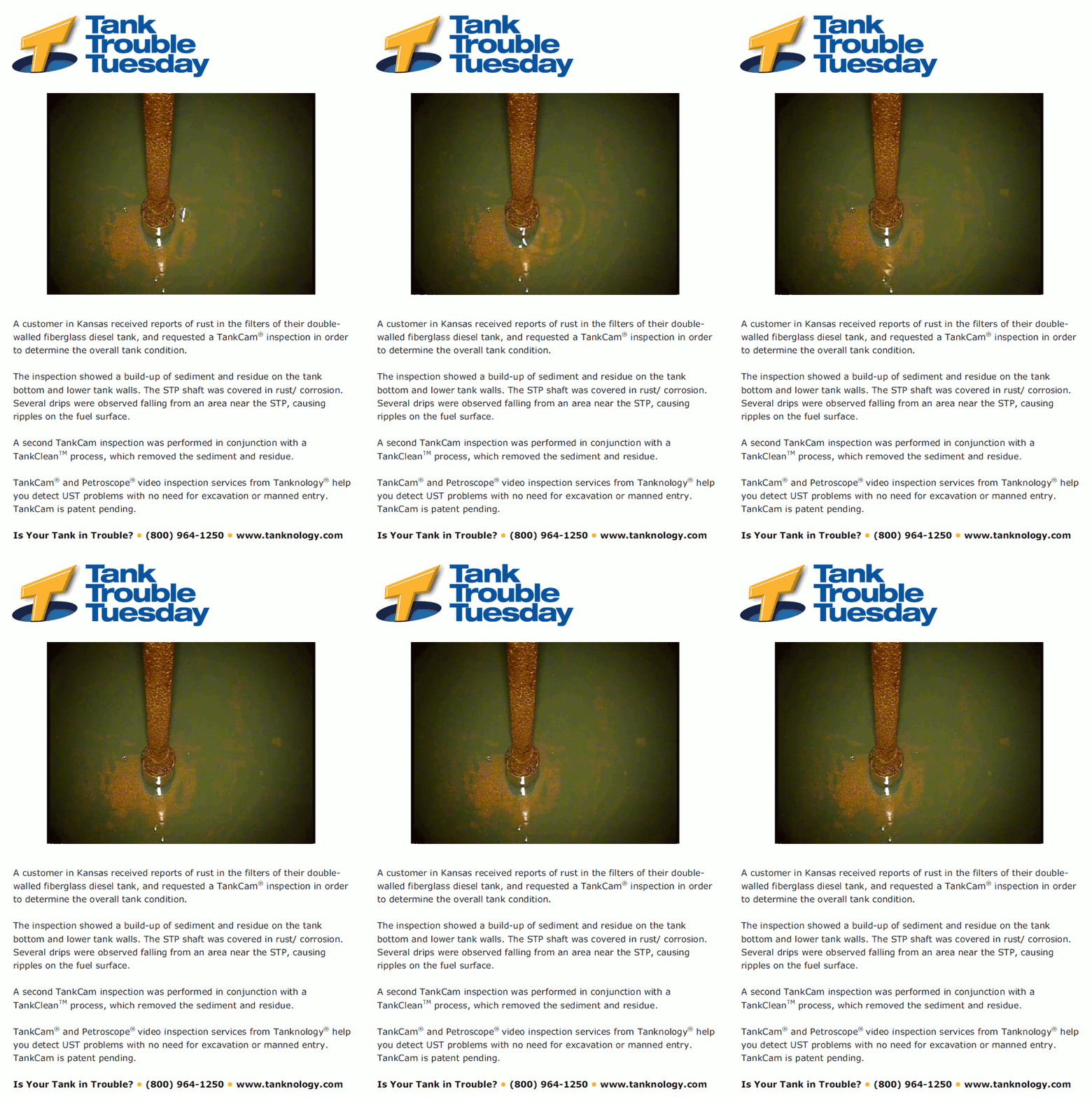
Occasionally we find fiberglass tanks in good condition with heavily corroded steel components, as was the case in this diesel tank in Kansas.

Sediment and residue present in the tank were later cleared away by our TankClean service, which is always performed in conjunction with a TankCam inspection-- which provides a live feed of the inside of the tank-- to assure the most thorough cleaning available on the market.


Tuesday, September 19, 2017

Tank Trouble Tuesday

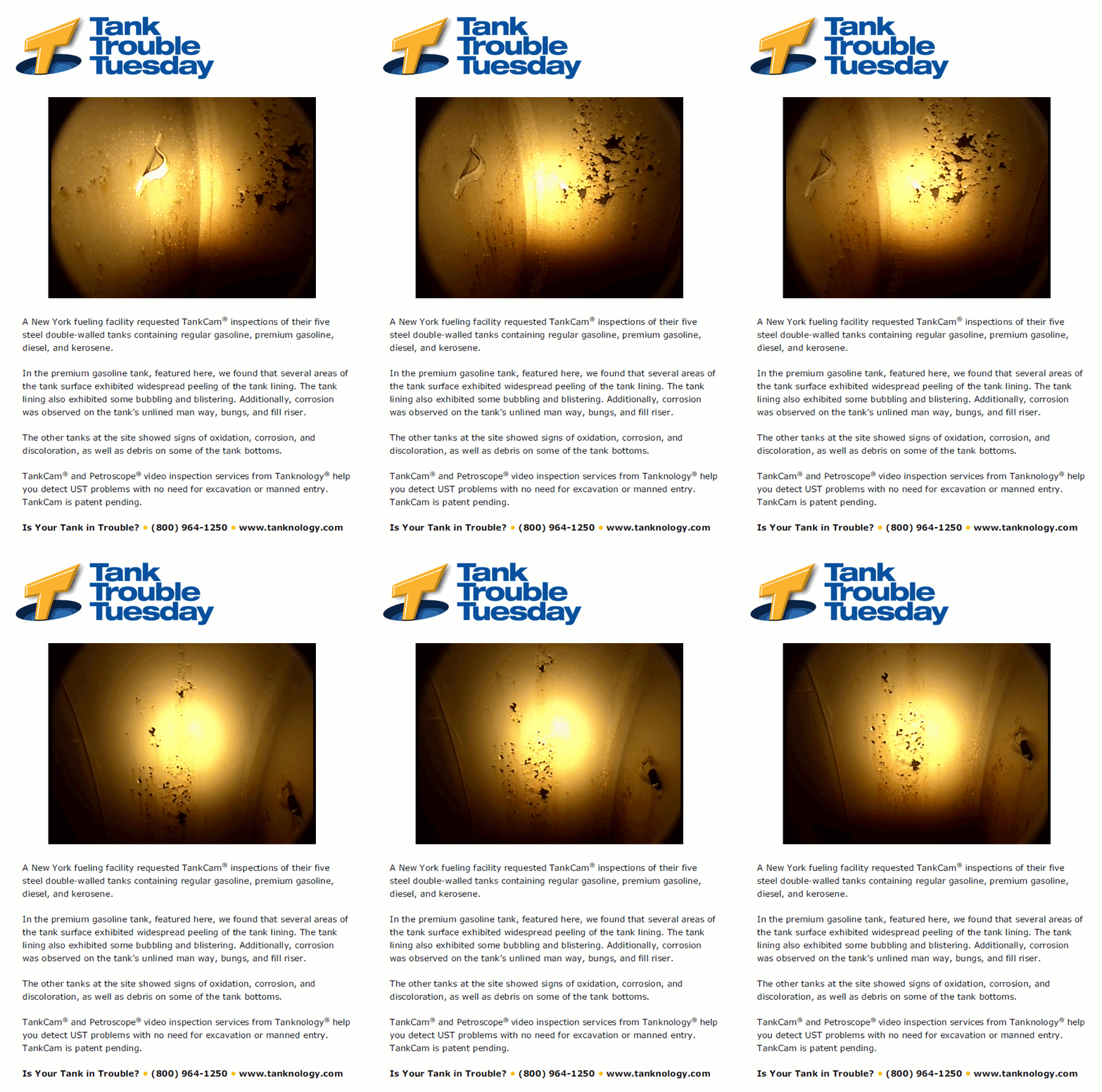
A site in New York requested TankCam® inspections to evaluate five double-walled steel USTs.

The premium tank was found to be lined, though the lining was failing due to blistering, bubbling, and widespread peeling, as shown below. 


Tuesday, September 12, 2017

Tank Trouble Tuesday

A customer in Texas noted a high water ATG alarm after a fuel delivery and called Tanknology to investigate.

We verified the ingress with our VacuTect® tightness test, and pinpointed the leak with our TankCam® inspection.

Read the full story in the GIF below!